Employing Energy-Based Technology
Alleviate dry eye disease symptoms and create cosmesis.
KEY TAKEAWAYS
- Energy-based technologies have shown to be effective in treating dry eye disease associated with ocular rosacea and meibomian gland dysfunction and in creating periocular and periorbital cosmesis.
- Energy-based treatments are often complementary rather than mutually exclusive when it comes to aesthetic outcomes.
- There is a rising demand for noninvasive and minimally invasive aesthetic treatments. Energy-based technologies fall under this treatment umbrella.
Optometrists should consider using in-office energy-based technologies originally created for aesthetics for three primary reasons:
- Energy-based technologies have shown to be effective in treating dry eye disease (DED).1,2
- Energy-based technologies can create periocular and periorbital cosmesis.3-5
- There is a rising demand for noninvasive and minimally invasive aesthetic treatments due to their safety profile and minimal downtime.6
When I first started practicing, one of my colleagues shared that most patients care about two things: whether their eyes look good or hurt. This statement has stayed with me because it has been proven true in many of the patients I’ve seen.
Based on what is outlined here, I discuss how each energy-based technology can treat DED and create periocular and periorbital cosmesis. Additionally, I provide related pro tips. Note: It is worth mentioning that in the optometric practice, these treatments are often complementary rather than mutually exclusive, as their use is typically integrated into the management of DED.
INTENSE PULSED LIGHT (IPL)
• Treating DED. IPL delivers broad-spectrum, noncoherent light that is selectively absorbed by chromophores, such as oxyhemoglobin, melanin, and water. Absorption of this energy leads to photothermolysis of abnormal superficial blood vessels, which is thought to reduce the release of inflammatory mediators along the eyelid margin. Through these vascular and antiinflammatory effects, IPL has been associated with improvements in meibomian gland function and gland expressibility. A secondary effect may include a reduction in periocular redness, contributing to a brighter and more even eyelid appearance.
The adverse events associated with IPL are generally mild and transient when the device is employed appropriately. The most common adverse events include transient erythema, warmth, and mild treatment-related discomfort. Less commonly, pigmentary changes, such as hyperpigmentation or hypopigmentation, may occur, particularly in patients who have darker skin types or inadequate sun protection, as well as superficial burns or blistering with high-energy settings.7,8
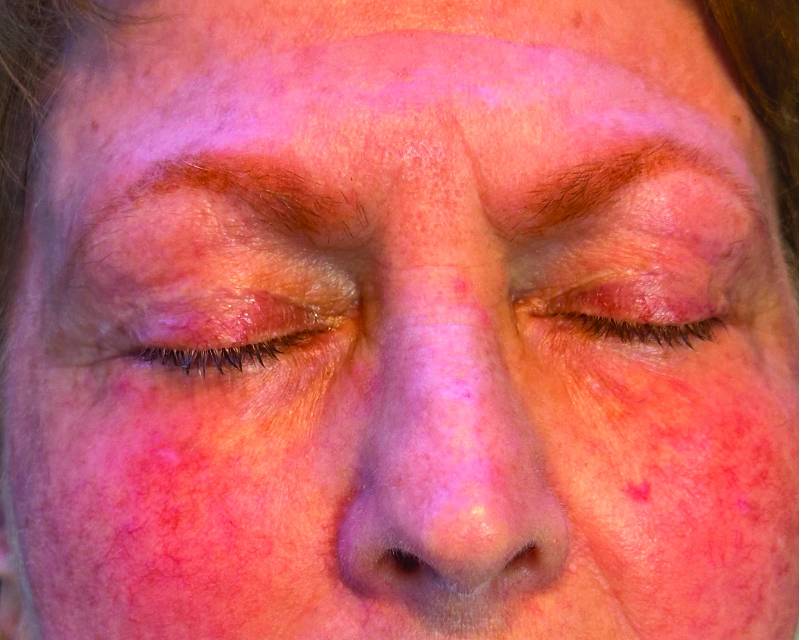
• Achieving cosmesis. IPL activates the dermis’ thermal response, remodeling connective tissue (Figure). Specifically, it improves both the density and tension of the skin by contracting the current collagen and stimulating fibroblasts to create new elasticity and viscoelasticity.9
Thus, it can be effective in treating dark circles under the eyes if the circles are due to vascular pooling or hyperpigmentation from medications such as prostaglandin analogs.9,10
• Pro tips. Apply IPL to the malar and periocular skin using a coupling gel to deliver sequential pulses from tragus to tragus, including the nose and infraorbital region. Appropriate ocular protection is required. Treatment parameters are adjusted based on skin type and device-specific guidelines.7,8 To improve IPL outcomes, prioritize appropriate patient selection, specifically focusing on patients who have ocular rosacea and meibomian gland dysfunction contributing to ocular surface disease. This is because these patients tend to demonstrate the most consistent clinical response.
LOW-LEVEL LIGHT THERAPY (LLLT)
• Treating DED. LLLT works through photobiomodulation. Specifically, photons delivered during treatment are absorbed by mitochondrial chromophores—particularly cytochrome c oxidase—leading to increased mitochondrial respiration, enhanced adenosine triphosphate production, and modulation of reactive oxygen species signaling pathways.11 These cellular effects may promote tissue repair, reduce inflammatory signaling, and support improved meibomian gland function and ocular surface homeostasis.11,12 Further, LLLT may improve eyelid region appearance through photobiomodulation effects that support collagen remodeling. The adverse events of LLLT are generally minimal, with most patients experiencing no significant discomfort. Reported events are typically mild and transient warmth or erythema.
• Achieving cosmesis. One randomized controlled study reported an approximate 30% reduction in periocular wrinkle volume with LLLT-based photobiomodulation.13
• Pro tips. Apply LLLT to the periocular region using a dedicated light-emitting device or mask to deliver controlled wavelengths of light to the closed eyelids for a predetermined duration. Treatment parameters vary by device and protocol. LLLT is typically delivered as a series of treatments, often consisting of several sessions spaced over a few weeks, with maintenance therapy as needed. To improve LLLT, incorporate it as part of a multimodal treatment approach, rather than relying on it as a standalone therapy. It’s also important to counsel patients on the importance of treatment consistency and realistic expectations, as benefits are typically gradual and cumulative.
NON-ABLATIVE THERMOMECHANICAL SKIN TREATMENT
• Treating DED. This device delivers contact-transferred heat from a high-temperature (385–400 °C) tip applied in brief, controlled pulses. The tip consists of an array of microscopic pyramidal structures, creating a superficial thermal effect in the tissue (usually 200–300 μm deep). This, in turn, generates a matrix of coagulation sites on the skin that result in dermal remodeling and collagen restructuring.14 This treatment was linked with a clinically and statistically significant improvement in DED symptoms.15 Specifically, these findings were supported by a decrease of 21.40 ± 15.08 (P < 0.001) in the Ocular Surface Disease Index, improvements in noninvasive tear breakup time, and a reduction in tear osmolarity from 299.8 ± 13.3 mOsm/L to 298.8 ± 15.6 mOsm/L. No adverse events or changes in vision (p = 0.310) or IOP were observed.

• Achieving cosmesis. The nonablative thermomechanical skin treatment was shown to be safe and effective in the treatment of periorbital rhytides.16
• Pro tips. Apply the device’s sterile titanium tip, which is part of the applicator, to the superior and inferior eyelids above the meibomian glands for a total of 40 pulses per lid (10 pulses per eyelid in two parallel rows of 5 pulses each on the lid) covering a total skin area of 12 cm on both eyes.16

RADIOFREQUENCY (RF)
• Treating DED. RF heats the dermis by delivering thermal energy generated by oscillating electrical currents. When applied to the eyelids with bipolar RF, this thermal effect may soften obstructed meibum and improve gland expressibility, while also promoting collagen remodeling within periocular tissues.17 Monopolar RF uses bulk heating to induce collagen remodeling, which may enhance skin tightening and improve eyelid apposition to the globe.
Early studies on RF in DED patients reveal improvements in tear breakup time, meibomian gland function, and patient-reported symptoms.17 The adverse events of RF are typically mild and transient erythema, warmth, and treatment-related discomfort. Less commonly, patients may experience edema, superficial burns, or temporary skin sensitivity, particularly with excessive energy settings or prolonged application.
• Achieving cosmesis. Research shows RF is both safe and effective in treating periorbital wrinkles via its ability to remodel collagen and tighten skin.18
• Pro tips. Apply RF to the periocular skin of the lower and upper eyelids using a conductive gel and a handheld applicator while avoiding direct contact with the ocular surface. Treatment parameters vary by device and protocol. Appropriate ocular protection should be used based on device specifications and treatment approach. To improve RF outcomes, incorporate meibomian gland expression immediately following treatment, as heat-induced softening of meibum can enhance gland clearance and improve treatment response.
SELECTING DEVICES
Choosing an energy-based device should be guided by practice-specific considerations: Device footprint and workflow integration influence whether a technology fits within clinic space and patient flow. Interoperability with existing diagnostic and treatment pathways can further enhance efficiency. The patient prevalence of ocular rosacea, meibomian gland dysfunction, cosmetic concerns, and variation in skin types is equally important. Ultimately, selecting a device that aligns with both the clinical needs of the patient population and the operational structure of the practice is key to successful implementation.
FORWARD-THINKING OUTLOOK
Combined therapy (LLLT, RF, and IPL) may increase cellular metabolism and improve DED symptoms and meibum expressibility, according to a recent study in Contact Lens and Anterior Eye. Additionally, a recent study in Clinical Ophthalmology reveals that combining multi-frequency RF, IPL, and meibomian gland expression was shown to improve both the signs and symptoms of meibomian gland dysfunction. Based on these findings, one or more multitechnology-based devices could be forthcoming.
Ready to Claim Your Credits?
You have attempts to pass this post-test. Take your time and review carefully before submitting.
Good luck!