KEY TAKEAWAYS
- Close to 8% of all cosmetic procedures in 2024 were for blepharoplasty, according to the most recent statistics from the American Society of Plastic Surgeons.
- Radiofrequency, plasma fibroblast therapy, thermomechanical devices, or energy-based devices can be beneficial for moderately complex ptosis.
- We can prepare patients for surgical procedures by educating them on what occurs and what they can expect postoperatively.
Close to 8% of all cosmetic procedures in 2024 were for blepharoplasty, according to the most recent statistics from the American Society of Plastic surgeons.1 Given this number, it makes perfect sense why so many of our patients are asking about how to fix their drooping upper lids. Accordingly, this article discusses how to manage patients seeking eyelid cosmesis for ptosis, organized by level of complexity.
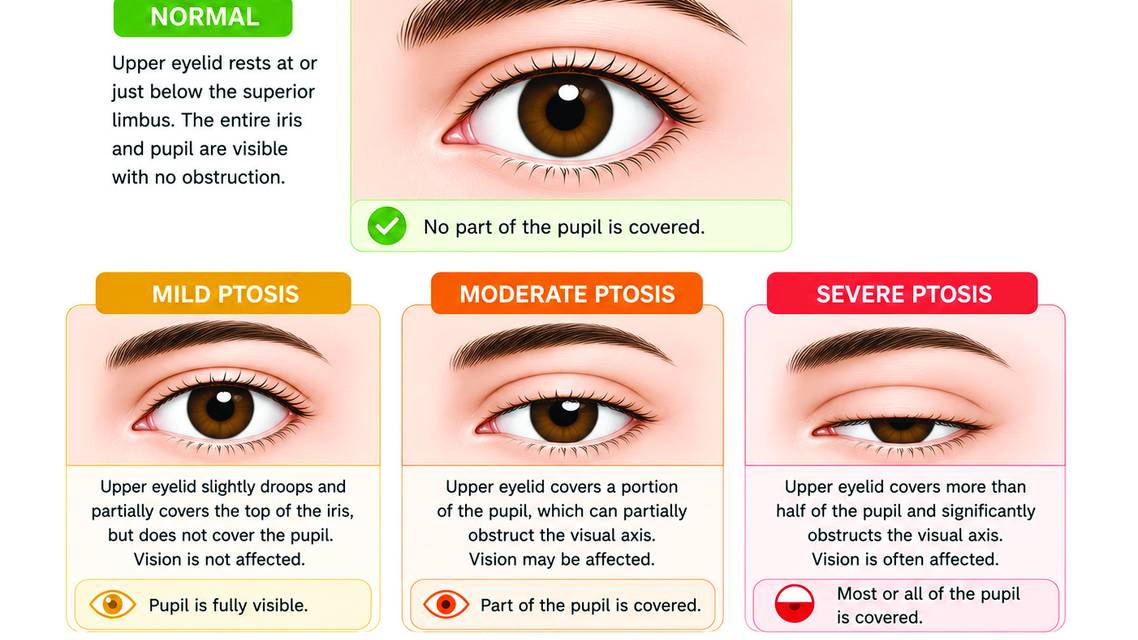
MILD COMPLEXITY (1-2 MM PTOSIS)
Upneeq (Oxymetazoline hydrochloride 0.1%, RVL Pharmaceuticals) is a nonsurgical, FDA-approved temporary intervention for mild-to-moderate ptosis. Specifically, the drop stimulates the contraction of Müller muscle, producing a roughly 1 mm to 2 mm lift that kicks in within 5 to 15 minutes and lasts about 6 to 8 hours.2,3 This makes it ideal for patients looking for a treatment for specific occasions, such as family gatherings, or events, such as school reunions. Common adverse reactions are punctate keratitis, conjunctival hyperemia, dry eye, blurred vision, instillation site pain, ocular irritation, and headache.
• Action steps. We should trial Upneeq in-office to set patient expectations and guide treatment decisions. Specifically, we should begin by measuring margin reflex distance (MRD)-1 in primary gaze (distance from the pupil center to the upper lid margin), capturing a photo of it, and documenting it. Next, we should instill 1 drop of Upneeq in the affected eye and reassess after 10 to 15 minutes. A normal MRD-1 is typically 4 mm to 5 mm; Upneeq produces an average lift of ~1 mm, though response varies. Next, we should capture a photo and document after-instillation measurements. Finally, we should review these results with the patient to determine whether the degree of lift aligns with their goals.

MODERATE COMPLEXITY (3–4 MM PTOSIS)
This is where radiofrequency (RF), plasma fibroblast therapy, thermomechanical devices, or energy-based devices can be beneficial. It is essential to differentiate true blepharoptosis from dermatochalasis, brow ptosis, lid laxity, or other causes of pseudoptosis, as energy-based treatments tighten skin but do not elevate a mechanically or neurologically ptotic lid.
RF delivers controlled dermal heat to promote collagen contraction and remodeling, producing gradual tightening over weeks to months. Ideal candidates have mild-to-moderate periocular skin laxity. Realistic expectations should be set regarding the results. (Patient education to manage these expectations is crucial.) Contraindications include active infection, impaired healing, pregnancy, and implanted electronic devices, such as pacemakers or defibrillators. The reasons for the latter: The electromagnetic fields generated from RF can interfere with implanted devices, causing a malfunction.
Plasma fibroblast therapy creates controlled superficial thermal injury to contract and remodel skin. It involves visible downtime and carries concern for pigmentary change, scarring, and ocular surface injury without proper protection.
Thermomechanical devices use heated tips to create fractional skin injury, improving crepey texture and mild lid laxity, and have a favorable safety profile.
Across all the aforementioned devices, common adverse events include transient erythema, edema, tenderness, and skin dryness, with less frequent risks of burns, scarring, or dyschromia. Ideal patients have pseudoptosis driven by excess skin or reduced tissue elasticity rather than true lid margin descent.
• Action steps. We should rule out differential diagnoses by measuring MRD-1 and assessing levator function, brow position, and lid crease height. Then, we should gently elevate redundant skin to determine whether the patient’s concern improves without lifting the lid margin. Next, we should document standardized photos in primary gaze with brows relaxed and elevated. If skin laxity is the primary driver, we should counsel the patient on nonsurgical options. However, if the patient has true ptosis, asymmetry, neurologic signs, or functional impairment, we should refer them for oculoplastic evaluation.
SEVERE COMPLEXITY (≥ 4 MM PTOSIS)
When patients have significant ptosis, we should consider referring them for brow suspension, levator resection/advancement, Müller muscle-conjunctival resection, or a Whitnall sling (advancing the Whitnall ligament and the levator muscle to the tarsal plate to improve eyelid elevation and contour). Ideal candidates present with true blepharoptosis, decreased MRD-1, and symptoms such as superior visual field loss, brow fatigue, or compensatory frontalis overaction.
• Action steps. We should prepare patients for these surgical procedures by educating them on what occurs and what they can expect postoperatively. As an example, when it comes to blepharoplasty, we should inform patients about related bruising, swelling, and possible temporary blurred vision.
AMERICAN SOCIETY OF PLASTIC SURGEONS TOTAL COSMETIC FACIAL PROCEDURES1
Buccal fat pad removal: 4,903
Cheek implant (malar augmentation): 9,130
Chin augmentation (mentoplasty): 5,529
Ear surgery (otoplasty): 4,825
Eyelid surgery (blepharoplasty): 120,755
Facelift (rhytidectomy): 79,058
Facial fat grafting: 34,260
Forehead lift: 13,621
Liposuction (submental/chin): 24,000
Neck lift: 22,445
Nose reshaping (rhinoplasty): 48,423
REINFORCING OUR VALUE
When a patient asks about how to “fix” the appearance of their lids, explaining their options for intervention reemphasizes to them why they’ve trusted us with their eye care.
FORWARD-THINKING OUTLOOK
A novel tissue-preserving upper blepharoplasty technique that tucks excess skin inward versus excising skin appears to offer a promising alternative to traditional upper blepharoplasty, according to a study in Aesthetic Surgery Journal. Specifically, it provides cosmesis with faster recovery and minimal scarring. That said, the study’s researchers note that “further studies are needed to evaluate long-term results and compare its efficacy.”
Ready to Claim Your Credits?
You have attempts to pass this post-test. Take your time and review carefully before submitting.
Good luck!