Botulinum Toxin Neuromodulation for Eyelid-Associated Ocular Surface Disease
Learn why this treatment strategy is needed.
KEY TAKEAWAYS
- Eyelid-associated ocular surface disease (EAOSD) is a mechanically driven cause of persistent OSD that flies under the radar of conventional dry eye disease.
- When symptoms are disproportionate to findings, or when improvement stalls despite appropriate care, friction-based disease deserves a closer look.
- Recognizing EAOSD opens the door to botulinum toxin neuromodulation as a treatment targeted at the pretarsal orbicularis oculi.
Eyelid-associated ocular surface disease (EAOSD) is a mechanically driven cause of persistent OSD that flies under the radar of conventional dry eye disease (DED).1 In patients who plateau despite optimized therapy, friction, not just inflammation or tear deficiency, may be the culprit.1-3 Without addressing that mechanical load, escalating treatments will hit a ceiling. Recognizing EAOSD opens the door to botulinum toxin (BTX) neuromodulation as a treatment targeted at the pretarsal orbicularis oculi.1
WHY DED WORKUPS FALL SHORT
Standard DED workups center on tear film instability, meibomian gland dysfunction (MGD), and inflammation. These are real and important issues, but they don’t explain every patient. Thus, when symptoms are disproportionate to findings, or when improvement stalls despite appropriate care, friction-based disease deserves a closer look.
The human eyelid makes contact with the globe more than 10,000 times per day.4 Even minor abnormalities in lid apposition, blink force, or tear lubrication can translate into significant repetitive microtrauma.1,2,4 Patients with incomplete blinking, orbicularis hyperactivity, tight lids, or concurrent MGD are especially vulnerable to this repetitive microtrauma.1,5-7
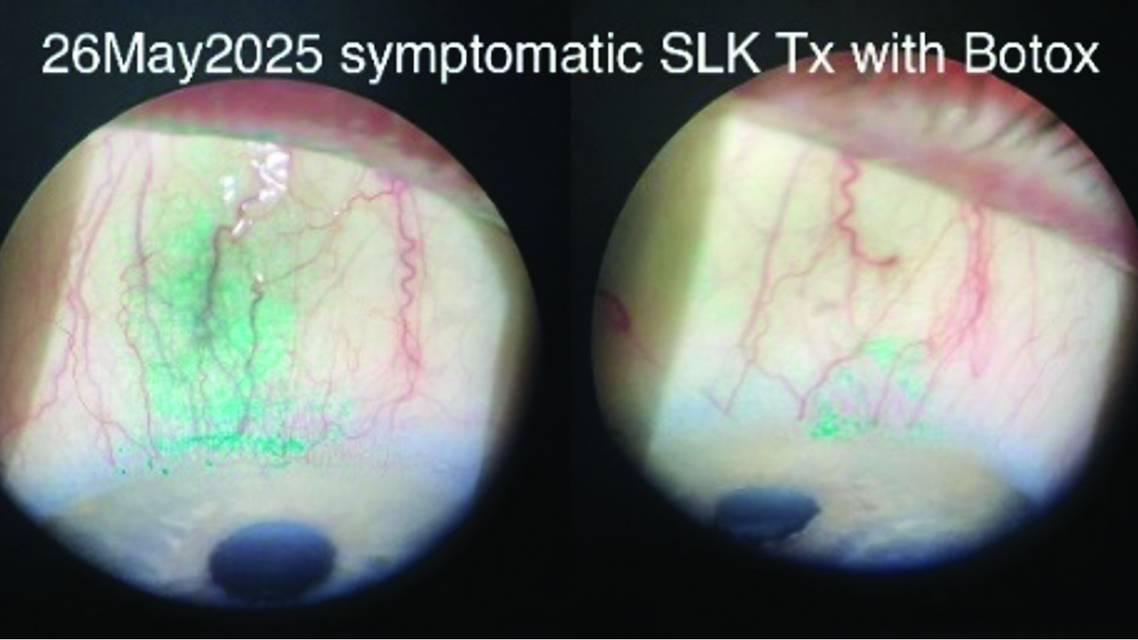
Classic signs include lid wiper epitheliopathy (LWE),8 superior limbic keratoconjunctivitis,9,10 mucous filaments,11 and large papillae on the superior tarsal conjunctiva.2
• Pro tip. Symptoms out of proportion to clinical findings are a red flag for a friction-based component. Don’t overlook the mechanics.
THE PATHOPHYSIOLOGY IN BRIEF
Friction-related damage emerges from three interacting factors: blink dynamics, tear film quality, and eyelid anatomy.12,13 Abnormal blink patterns concentrate lid pressure along the lid wiper zone.7 Poor lubrication amplifies that friction with each blink. Structural factors, such as tight lids or altered lid-globe angles, further compound microtrauma.4 Downstream effects include superior corneal staining, filament formation,11 and focal tear film instability that persists regardless of therapy.5
• Pro tips. Superior corneal staining and lid wiper changes are hallmarks of an elevated mechanical load.1 Manual elevation or upper lid repositioning that reduces symptoms implicates a friction-driven etiology.1
WHEN STANDARD THERAPIES FAIL
Most DED therapies address inflammation or tear film quality; they do not reduce mechanical force.2This creates a predictable treatment gap:
- Lubricants are cleared rapidly with each blink.14
- While immunomodulators improve goblet cell density15 and perfluorohexyloctane has been shown to reduce lid wiper epitheliopathy,16 in more advanced cases of EAOSD these strategies may be insufficient..
- Thermal therapies improve meibum quality, but don’t reduce lid pressure.17
- Surgical options remain reserved for advanced or refractory cases.10,17
• Pro tips. Address the mechanical component or treatment will plateau, no matter how aggressively the tear film is managed.
BTX: TARGETING THE SOURCE
BTX neuromodulation offers a precision approach: reduce orbicularis activity, soften blink force, and protect the ocular surface without eliminating blinking altogether.13,18,19
Microdose injections (0.025–0.05 cc, at a concentration of 4 units/0.1 mL) into the pretarsal orbicularis oculi reduce excessive muscle contraction and decrease lid-globe contact pressure.1,20,18 This results in gentler blink mechanics, decreased lid-globe pressure, and a more favorable environment for corneal and conjunctival epithelial healing (Figure 1).1,7,21 Because BTX does not eliminate blinking, it provides a controlled reduction in friction without compromising essential eyelid function.1,20,19

CLINICAL BENEFITS
- Reduction in superior corneal staining and LWE (Figure 2)22
- Decreased mucous filament formation23,24
- Improved tear film stability22
- Enhanced epithelial healing environment23
Onset of effect typically occurs within days of injection.1 Adverse effects are uncommon when dosing is conservative and technique is precise.1,20,22
• Pro tip. Injection placement must be pretarsal and avoid the levator to minimize ptosis risk.1
BTX is best understood as an adjunct to, not a replacement for, foundational DED therapy. It targets a specific mechanism other treatments cannot reach.1

WHO IS A GOOD CANDIDATE?
Strong candidates typically have:
- Persistent superior corneal staining refractory to conventional therapy.1,24,21
- Limited or plateaued response to antiinflammatories and lubricants.25
- Symptom relief when the upper eyelid is manually repositioned.1,10
- Clinical or observational evidence of orbicularis hyperactivity.20,26
• Pro tip. Use the eyelid reposition test. If it relieves symptoms, friction is likely a key driver.
Patients should understand that BTX effects are temporary, typically 3 to 4 months, so repeat injections may be needed.1,18,27 Ongoing DED management remains essential between cycles.
ADDRESS THE FRICTION
EAOSD represents a mechanical driver of DED that standard related treatments frequently miss.1,4 For patients who continue to struggle despite thorough conventional care, addressing friction is not optional—it is essential.1,4
BTX neuromodulation offers a targeted, evidence-based way to reduce lid-globe pressure, improve blink mechanics, and support epithelial recovery.1 While more research is underway, early evidence and clinical experience suggest neuromodulation, when thoughtfully integrated into a comprehensive treatment plan, can meaningfully change outcomes for EAOSD patients.1,18,19
Ready to Claim Your Credits?
You have attempts to pass this post-test. Take your time and review carefully before submitting.
Good luck!