
Editorially independent content, supported with advertising by Astellas
GA Case Compendium: Identification of Geographic Atrophy on Color Fundus Photography

THIS CASE IS INTERACTIVE!
Strengthen your understanding of geographic atrophy by answering the challenge questions below.
CASE PRESENTATION
Color fundus photography (CFP) is the historical standard for diagnosing geographic atrophy (GA) in age-related macular degeneration (AMD). Due to the broad-spectrum illumination used in this imaging method, it has a high correlation with ophthalmoscopy, and thus, CFP is a useful adjunct to the physical examination. While CFP has some important limitations—notably, that lower contrast makes it challenging to identify precise borders—it is useful for identifying a wide array of phenotypic alterations associated with AMD.
In the following, I will present four cases that show the hallmark appearance of GA secondary to AMD on CFP imaging.
Case #1
A 75-year-old White woman presented for a comprehensive eye examination. The patient’s history was positive for hypercholesterolemia and osteoarthritis. Presenting BCVA was 20/200 in each eye. Based on the physical examination and CFP imaging, the patient was diagnosed with bilateral AMD and GA in both eyes (Figure 1). The patient was referred to a retina specialist and is participating in a clinical trial for a complement inhibitor. A low vision referral was also made at that time. She has since started to receive intravitreal injections of a complement inhibitor every 4 weeks.

Case #2
A 90-year-old White man presented for a comprehensive eye examination. The patient had a history of hypercholesterolemia. At the time of the examination, the patient reported taking AREDS supplementation. His BCVA was 20/25 OD and 20/40 OS. Based on the physical examination and CFP imaging, the patient was diagnosed with dry AMD with drusen, pigment mottling, and GA in both eyes (Figure 2). The patient was referred to a retina specialist for evaluation and possible participation in a complement inhibitor clinical trial. To our knowledge, he has not started to receive intravitreal injections as treatment for his GA.
Case #3
An 85-year-old White woman presented for a comprehensive eye examination. The patient had a history of hypercholesterolemia and diabetes. At the time of the examination, the patient reported taking AREDS supplementation. Her BCVA was 20/400 OD and 20/200 OS. Based on the physical examination and CFP imaging, the patient was diagnosed with dry AMD with drusen and GA both eyes (Figure 3). The patient was referred to a retina specialist for evaluation and possible participation in a complement inhibitor clinical trial. A low vision referral was also made. To our knowledge, she has not started to receive intravitreal injections as treatment for her GA.
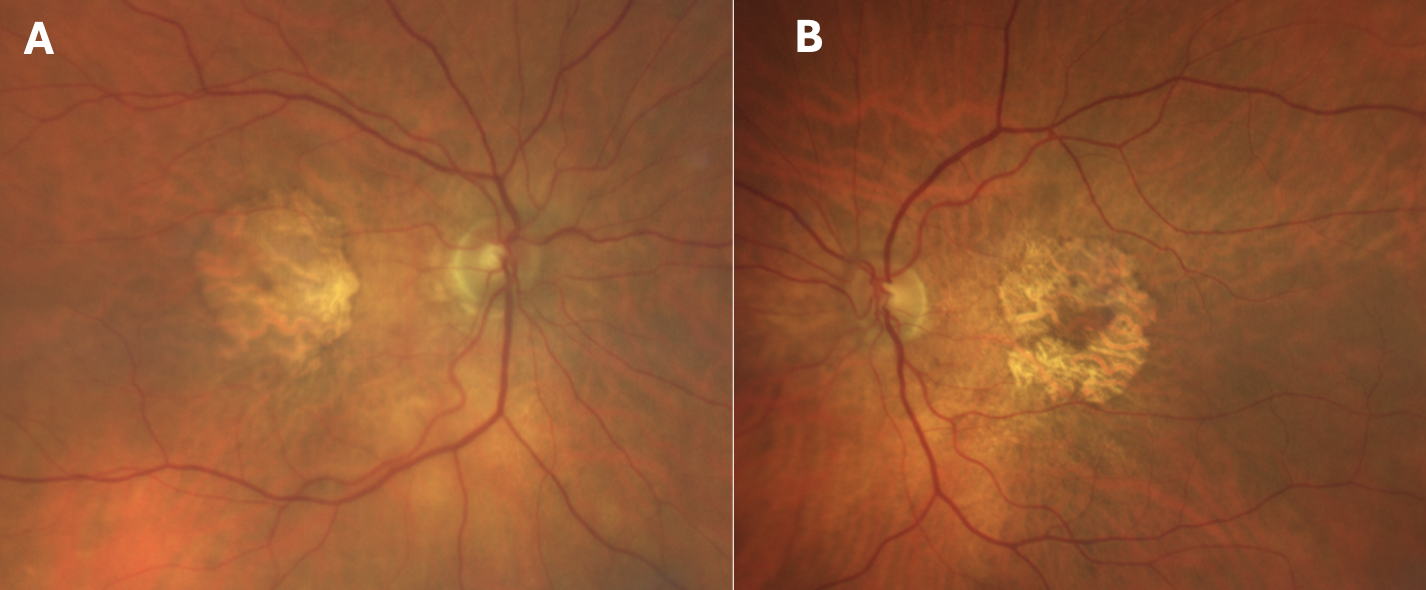
Case #4
An 89-year-old White man was evaluated in our clinic. There was a history of a disciform scar in the right eye from a prior choroidal neovascular membrane. In the left eye, our examination revealed dry AMD with scattered hard drusen and early non-central GA (Figure 4). His BCVA was hand motion OD and 20/25 OS. The patient is currently being followed by an optometrist. The patient uses AREDS supplementation regularly.
Summary/Clinical Take-Home
As our knowledge of the immune system is better understood, patients with age-related macular degeneration have more treatment options than ever before. Patients with the geographic atrophy variant of the disease process should strongly be considered for a clinical trial to try to effectively reduce the lesions' growth and ultimately preserve vision.
Ready to Claim Your Credits?
You have attempts to pass this post-test. Take your time and review carefully before submitting.
Good luck!
Recommended
 Geographic Atrophy Case Compendium
GA Case Compendium: Challenges in Patient Education and Treatment Decision-Making for Geographic Atrophy
Roya Attar, OD, MBA, DHARoya Attar, OD, MBA, DHA- Geographic Atrophy Case Compendium
GA Case Compendium: Collaborative Care to Improve Patient Adherence to Therapy
Damon DierkerDamon Dierker - Geographic Atrophy Case Compendium
Clinical Case Compendium: A Journey Through Detection, Treatment Initiation, and 2 Years of Active Complement Inhibition
jessicahaynesodjessicahaynesod