Psychogenic Amblyopia
Here’s how to differentiate this condition from similar types of vision loss—and how to manage these patients.
As psychogenic amblyopia can mimic true amblyopia, making a differential diagnosis is essential for appropriate management. Inappropriate management can result in postponed recovery from the real diagnosis. This month’s column defines psychogenic amblyopia, how to arrive at the diagnosis, and how to manage the condition.
DEFINING PSYCHOGENIC AMBLYOPIA
Psychogenic amblyopia presents as vision loss in the absence of ocular disease or functional amblyogenic risk factors, setting it apart from true amblyopia. Psychological stress often contributes to the vision loss.1 The estimated prevalence of psychogenic amblyopia is 1% to 5% in school-aged children. Females are affected at a greater proportion than males.2 Also, unlike functional amblyopia, the condition is a diagnosis of exclusion characterized by normal ocular health, minor refractive error, tubular field, and no mobility problems.3 Additionally, while the condition can occur at any age, it is most often observed in the second decade of life, with its highest occurrence found in those 11 to 20 years of age.4 The timeline to resolution varies from days to years, with the median time taking 2 months.5,6

ARRIVING AT A DIAGNOSIS
• Obtain a Detailed History. Pinpointing potential stressors that line up with the occurrence of the vision loss can help uncover its underlying cause. Questions that are worth asking in a patient history form can include: Have there been any recent major life changes? Is there anything going on at home, work, or school that may be adding stress to your life? Have you had any health changes or new diagnoses? Likening psychogenic amblyopia to other psychosomatic conversion-type disorders can help patients and their caregivers think about the context of their recent history and name stressors they weren’t otherwise thinking of. Additionally, case history may provide more insight if patients and caregivers are separated, so consider asking your staff to help conduct separate histories.
• Evaluate Refractive Error. This is to ensure functional amblyopia is not missed. To accomplish this, employ cycloplegic retinoscopy to rule out latent hyperopia and identify the true amount of anisometropia present;remember, it only takes 1 D of hyperopic anisometropia to cause unilateral amblyopia.
• Examine the Posterior Segment. Perform OCT to exclude subtle retinal and/or optic nerve pathology. For example, a patient might have subtle optic nerve hypoplasia that has yet to be diagnosed. Early stages of inherited retinal dystrophies may also present as vision loss with no obvious sign of ocular disease on clinical examination.An OCT could help identify early changes.
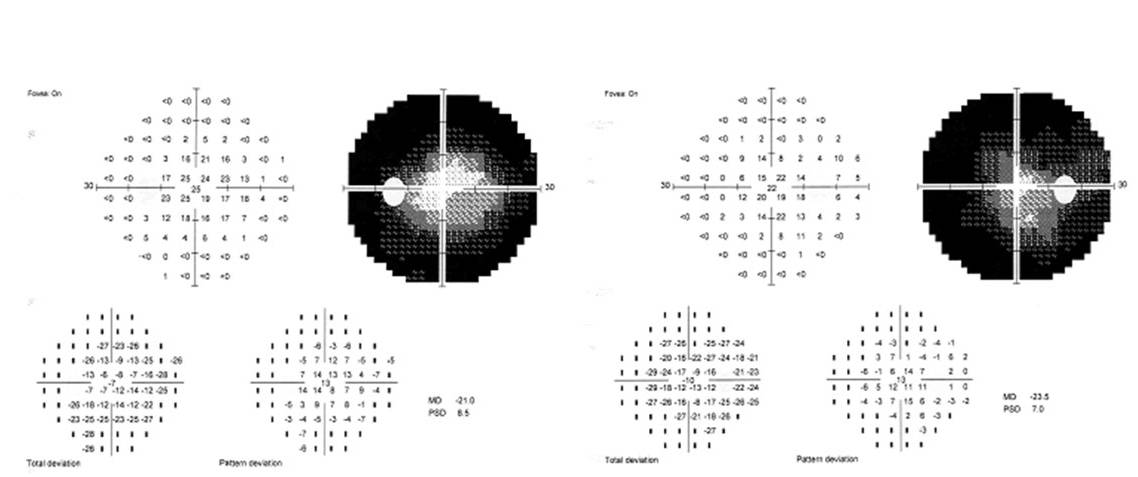
• Conduct Visual Field Testing. Do this to look for tubular field, which is the classic visual field loss seen in psychogenic amblyopia.7 Specifically, use a tangent screen, with the patient moved back from the screen for a second test of the visual field that results in the same plotted field (Figure 1). Restricted fields can also be detected with automated visual field instruments (Figure 2).

MANAGING THE CONDITION
• Educate Patients. Emphasize to patients and their caregivers that psychogenic amblyopia vision loss is a real loss of vision that should resolve with time, especially when the psychological stressor is addressed. Doing so validates the patient’s symptoms and puts both the patient and their caregiver at ease.
• Collaborate and Comanage. Discuss with the pediatrician your findings, and suggest a referral for psychological counseling, so the patient can get the mental help they need to regain their full vision.
• Monitor Closely. If vision does not improve, additional testing and/or diagnostic referrals are warranted to avoid missing comorbid ocular or neurological conditions.Also, consider referrals for retinal electrodiagnostics to rule out inherited ocular diseases, such as Stargardt disease, and neurology and/or neuro-ophthalmology for MRI or other imaging to rule out potential neuropathology, such as a space-occupying lesion and/or tumor.
CONSERVATIVE CARE
If properly educated on the importance of monitoring for worsening vision and returning for follow-up, these patients can be successfully managed with a conservative approach that still prioritizes successful outcomes. Should a patient require further workup after their first visit, they can always be referred.
FORWARD-THINKING OUTLOOK
As optometry’s scope continues to expand—and with optometrists playing a larger role in collaborative care with healthcare providers outside of eye care—it is possible that ODs could be the first to manage conversion disorders. As such, understanding the pathogenesis and natural history of psychogenic amblyopia will allow optometrists to guide their patients through the visual prognosis, as well as help them consider other avenues that may be needed for additional treatment.
Ready to Claim Your Credits?
You have attempts to pass this post-test. Take your time and review carefully before submitting.
Good luck!