
A Review on Identifying and Explaining Cataracts
Consider symptoms, specific diagnostics, a myth, and a patient-facing script.
KEY TAKEAWAYS
- A nuclear sclerotic cataract appears brown or yellow.
- Empathy and framing a cataract as an opportunity, not a burden, can be effective in communicating the diagnosis.
- While visual acuity must be documented for insurance coverage of the procedure, there is no magic number.
The diagnosis of cataracts and, therefore, the journey toward surgery often begins in our chairs. As a result, it makes sense to review how to identify the different forms of cataracts and, more importantly, bridge diagnostic findings to meaningful patient education.
IDENTIFYING CATARACTS
This is all about telltale symptoms and employing diagnostic testing.
• Telltale Symptoms. “Glare at night” is the most common chief complaint of cataracts. When I hear this from a patient, my next question is, “Is it constant, or does it come and go?” I find this a crucial question to discern whether the patient has an ocular surface issue, such as dry eye disease, or a different, more stable refractive error.
If the patient replies that this symptom persists regardless of an updated glasses prescription and their vision remains stable throughout the day or with blink, cataracts are high on my differential diagnosis list. That said, I also consider other conditions, including corneal dystrophies or vitreoretinal diseases, that can have more persistent visual impacts.
• Diagnostic Testing. To make a definitive diagnosis, I am very systematic with my exams. Specifically, I start at the front and move backward. Dramatic refractive shifts suggest significant lenticular change. In a nuclear sclerotic cataract, this would present as myopic. In a cortical and, sometimes, posterior subcapsular cataract, this would present as hyperopic.

Additionally, a simple glare test via a brightness acuity tester (or even a bright penlight) while the patient is reading the Snellen chart aids in the cataract diagnosis. As a reminder, this is because a cataract causes the scattering of incoming light, which hinders the patient’s reading ability. When considering the effect of glare, it’s important to remember that patients who have larger pupils (around 5 mm to 6 mm, more often younger patients in their 40’s or 50’s) are naturally impacted greater by glare.
Next, a comprehensive dilated examination is critical to evaluate the internal ocular structures and identify any pathology that may be contributing to the patient’s visual symptoms. I also find value in objective testing, including contrast sensitivity and aberrometry, to better identify and quantify the impact of light scatter. Finally, OCT can help us assess the vitreous and retina for conditions that may also reduce visual quality. Significant vitreous opacities, for example, can contribute to light scatter, making distinguishing lenticular changes from posterior segment pathology important.
There are several types of cataracts. Nuclear sclerotic, being the most common, often starts in a patient’s early 60’s. Symptoms usually align with what was discussed earlier: glare and reduced contrast sensitivity, usually worse at night.
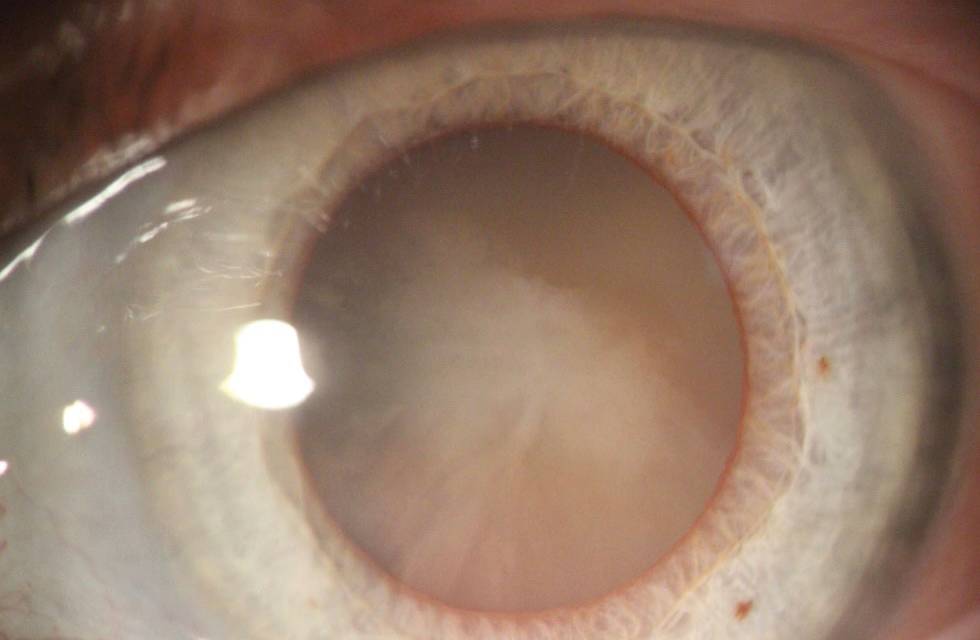
A nuclear sclerotic cataract appears brown or yellow, more noticeable toward the center or nuclear portion of the lens, becoming denser over time (Figure 1). A posterior subcapsular cataract and cortical cataract, while not always following age norms, can be much more visually compromising. A posterior subcapsular cataract often progresses more rapidly than a nuclear cataract. Appearing smaller and more granular or plaque-like, a posterior subcapsular cataract is often directly in the visual axis. Despite its smaller size, its central location can have a greater negative visual impact.
Cortical cataract opacities on the other hand appear whiter and spoke-like (Figure 2).They begin on the outer edge extending inward and in mature stages appear like spokes on a bicycle wheel.
There are other less common types of cataracts, including anterior subcapsular, diabetic, and congenital. These types differ in their location, appearance, size, and underlying cause. All can lead to visual symptoms that vary in severity. Compared with a nuclear sclerotic cataract, these other types often appear more distinctly opaque, and patients who have them may report a more rapid onset of glare and visual disturbances. In some cases, this can also lead to symptoms of monocular diplopia due to irregular light scatter and induction of severe higher-order aberrations.

DISPELLING A MYTH
A common myth I hear from colleagues is that there is a certain level of visual acuity (VA) a patient must fall below to qualify for cataract surgery. While VA must be documented for insurance coverage, there is no magic number. There simply must be a documented negative effect on activities of daily living.1 Other indications that can drive the decision to proceed with surgery include:
- Concomitant disease, such as diabetic retinopathy, that requires management prevented by the presence of a cataract.
- Lens-induced disease (ie, phacomorophic glaucoma).
- High risk of expedited cataract development because of a concomitant procedure (ie, membrane peel, intravitreal injection).
- Intolerable anisometropia following cataract surgery on the fellow eye.
EXPLAINING A CATARACT
Let’s remember that the cataract diagnosis can be overwhelming for patients. We are asking these patients to understand they have a visually compromising pathology that is only remediable by surgery. On top of that, they must select an IOL that may carry significant out-of-pocket expense (see “Educating Patients on IOL Options”). With advanced technology comes elevated patient expectations. Because of this, patient education is a more important part of the process than ever before.
Therefore, empathy goes a long way. Empathy in this setting begins with active listening. This means taking the time to understand symptoms, concerns, lifestyle, and visual goals. Doing so not only helps build trust, but also guides recommendations that align with unique visual objectives. I have found that patients who feel heard are more likely to feel confident in their eyecare team and ultimately more satisfied with their surgical experience.
FORWARD THINKING OUTLOOK
Aldose reductase inhibitors, protein aggregation inhibitors, and small-molecule chaperones have shown potential in either restoring or stabilizing lens protein structure and transparency, according to a recent study in The International Journal of Molecular Sciences. That said, the study’s researchers note that, “further research is needed to optimize drug-delivery systems to the lens, assess long-term safety, and confirm the clinical efficacy of these treatments.”
Additionally, a classic systemic review comparing the effectiveness of patient education strategies for cataracts shows that targeted interventions, such as a set of pictograms, a pamphlet, video, or computer tutorial, in addition to interpersonal instruction were the most effective.2
As a result, the authors of the review suggest these targeted interventions “may represent the best strategy for promoting effective learning in cataract surgery patients.”
Another strategy that I’ve noted goes a long way anecdotally: framing cataracts as an opportunity, not a burden:
“Congratulations—you have cataracts! This is a clouding of the natural lens, which is why you’re experiencing visual symptoms, such as glare. A relatively simple surgery is available that replaces your natural lens with an upgrade. I realize surgery can seem intimidating, but this is a routine surgery that continues to evolve with modern techniques and replacement lenses that can provide high-safety profiles and satisfactory visual outcomes.”
The word “can” is intentional. While cataract surgery has an excellent safety profile and outstanding success rates with advanced IOLs, no surgical outcome is guaranteed. As stated earlier, setting realistic expectations helps align patients’ goals with what modern IOLs and surgical techniques are capable of.
IT'S A PROCESS
Cataract surgery is much more than a 10-minute procedure, it’s a process. The management leading up to surgery day, and the care that follows are just as critical to visual success as the procedure itself. The referring optometrist should take pride in their role in the process, advocating for the patient toward vision and lifestyle improvement.
Ready to Claim Your Credits?
You have attempts to pass this post-test. Take your time and review carefully before submitting.
Good luck!
Recommended
 Cataract/Refractive Surgery
The Pursuit of Postop Happiness
Justin Schweitzer; Selina McGee, OD, FAAOJustin Schweitzer; Selina McGee, OD, FAAO- Cataract/Refractive Surgery
Establishing a Practical Collaborative Care Protocol
Gabrielle Anderson, OD; Mitch Ibach, OD, FAAOGabrielle Anderson, OD; Mitch Ibach, OD, FAAO