
Ocular Therapeutix Gains New Indication for Dextenza to Include Treatment of Ocular Itching Associated with Allergic Conjunctivitis

Ocular Therapeutix announced the FDA has approved its supplemental new drug application (sNDA) to broaden the Dextenza label to add an additional indication for the treatment of ocular itching associated with allergic conjunctivitis. With the approval, Dextenza is the first, FDA-approved, physician-administered intracanalicular insert capable of delivering a preservative-free drug for the treatment of ocular itching associated with allergic conjunctivitis with a single administration for up to 30 days.
Dextenza originally received FDA approval in November 2018 for the treatment of ocular pain following ophthalmic surgery, followed by an expansion of the label to also include the treatment of ocular inflammation following ophthalmic surgery in June 2019.
“Allergic conjunctivitis is a common condition seen in the offices of eye care providers. We are really excited about this label expansion and the potential benefits for patients,” Michael Goldstein, MD, President, Ophthalmology and Chief Medical Officer, said in a company news release. “The use of topical steroids is an important part of our current clinical armamentarium in the treatment of allergic conjunctivitis. Dextenza can now provide an office-based, physician-administered, preservative-free method of steroid delivery that benefits patients with ocular itching associated with allergic conjunctivitis.”
“We appreciate the FDA’s hard work and ability to complete its review of our sNDA ahead of the scheduled October 18th PDUFA date,” said Antony Mattessich, President and Chief Executive Officer of Ocular Therapeutix. “It is hard to overstate the strategic importance of this label expansion for Ocular Therapeutix. Allergic conjunctivitis, as our first in-office indication, lays the foundation for the rest of our pipeline.”
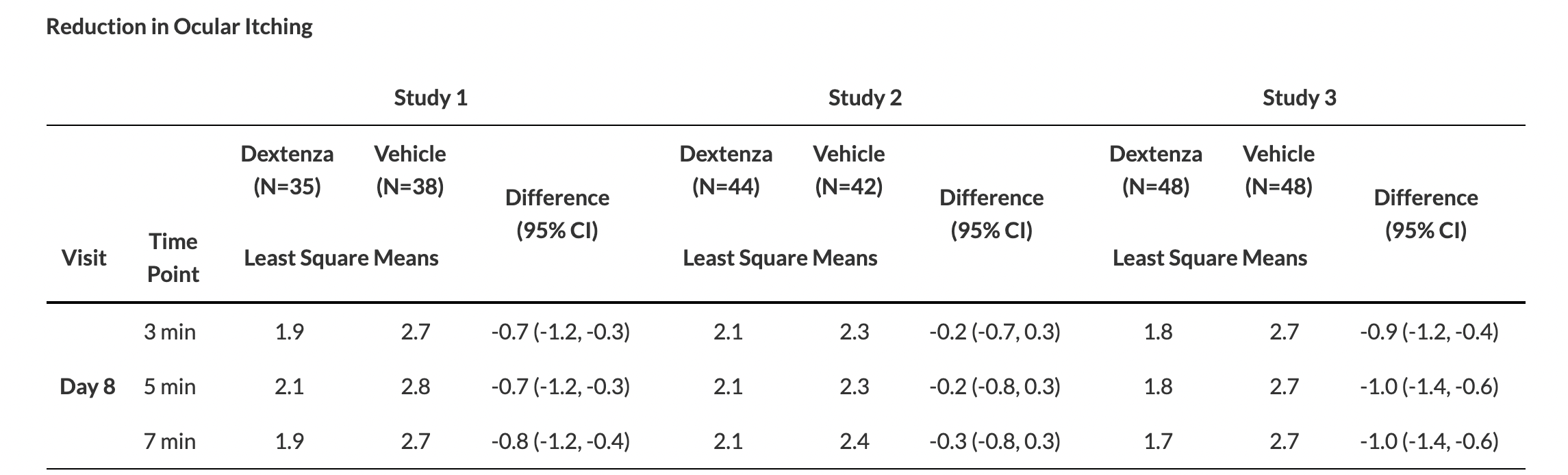
The efficacy of Dextenza for the treatment of ocular itching associated with allergic conjunctivitis was based on three randomized, multicenter, double-masked, parallel group, vehicle-controlled studies in subjects with a positive history of ocular allergies and positive skin test reaction to perennial and seasonal allergens (n=255). In all three trials, Dextenza demonstrated lower mean ocular itching scores compared with the vehicle group at all time points throughout the study duration of up to 30 days. In two of the three studies, a higher proportion of patients had statistically significant reductions in ocular itching on Day 8, at 3 minutes, 5 minutes and 7 minutes post-challenge in the Dextenza group compared to the vehicle group. Data for the primary endpoint, ocular itching at Day 8, is shown below for all three studies (scale 0-4):
Dextenza was observed to have a favorable safety profile and be generally well-tolerated in the allergic conjunctivitis as well as the ocular inflammation and pain clinical populations. The most common ocular adverse events seen in the pooled analysis of the allergic conjunctivitis studies were: increased intraocular pressure (3%), increased lacrimation (1%), eye discharge (1%) and reduced visual acuity (1%). The most common non-ocular adverse reaction that occurred in patients treated with Dextenza for allergic conjunctivitis was headache (1%).