
Clearside Biomedical Announces Positive Results in Safety, Durability and Biologic Effect in OASIS Phase 1/2a Clinical Trial of Suprachoroidal CLS-AX in Wet AMD Patients
Clearside Biomedical announced positive results from its OASIS phase 1/2a clinical trial of CLS-AX (axitinib injectable suspension) administered by suprachoroidal injection via Clearside’s SCS Microinjector in wet age-related macular degeneration (AMD) patients. Trial results include final 3-month data from all 4 cohorts, and interim data from the Extension Study that follows participating patients for a total of 6 months after a single dose of CLS-AX.
“We are strongly encouraged by the results we reported today which highlight the potential use of CLS-AX, a highly potent tyrosine kinase inhibitor combined with targeted SCS delivery, in serious retinal disease," Thomas A. Ciulla, MD, MBA, Chief Medical Officer and Chief Development Officer, said in a company news release. "In the four dose-escalating cohorts of the OASIS trial, we enrolled a total of 27 highly treatment-experienced wet AMD patients with active disease at screening. CLS-AX was well tolerated and demonstrated a positive safety profile across all timepoints and doses. Interim data from the Extension Study in Cohorts 3 and 4 showed the supplemental anti-VEGF injection-free rate up to each visit was 88% (7 of 8 patients) to Month 5 and 75% (3 of 4 patients) to Month 6, and at least a 90% reduction in treatment burden to date compared to the patients’ 6-month anti-VEGF therapy prior to receiving CLS-AX. In addition, there were observable signs of biologic effect with stable mean Best Corrected Visual Acuity (BCVA) and stable mean Central Subfield Thickness (CST) throughout OASIS and the Extension Study at all timepoints to date.”
“The positive safety results seen in all four cohorts, combined with evidence that CLS-AX showed biologic effect in a difficult to treat patient population, supports our belief that CLS-AX has the potential to treat retinal diseases with a repeatable, reliable, and validated in-office delivery approach using our SCS Microinjector. We are finalizing the optimal path forward for CLS-AX in retinal diseases including wet AMD and/or diabetic retinopathy. We are actively preparing for and expect to initiate a randomized, controlled Phase 2 clinical trial in the first quarter of 2023,” Dr. Ciulla concluded.
“Real world outcomes in patients with wet AMD continue to be poor due to high treatment burden and missed visits, which drives retinal specialists to look for better treatment options that are safe, effective, and provide a better quality of life for our patients. This CLS-AX data is quite promising as the optical coherence tomography (OCT) images show a biologic effect while extending the time for retreatment out for several months. CLS-AX, combined with the convenience and reliability of the suprachoroidal injection procedure, may be a valid future approach for treating a variety of retinal disorders,” added Arshad M. Khanani, MD, MA, FASRS, Managing Partner, Director of Clinical Research, and Director of Fellowship at Sierra Eye Associates, and Clinical Associate Professor at the University of Nevada, Reno School of Medicine.
Summary of OASIS Data
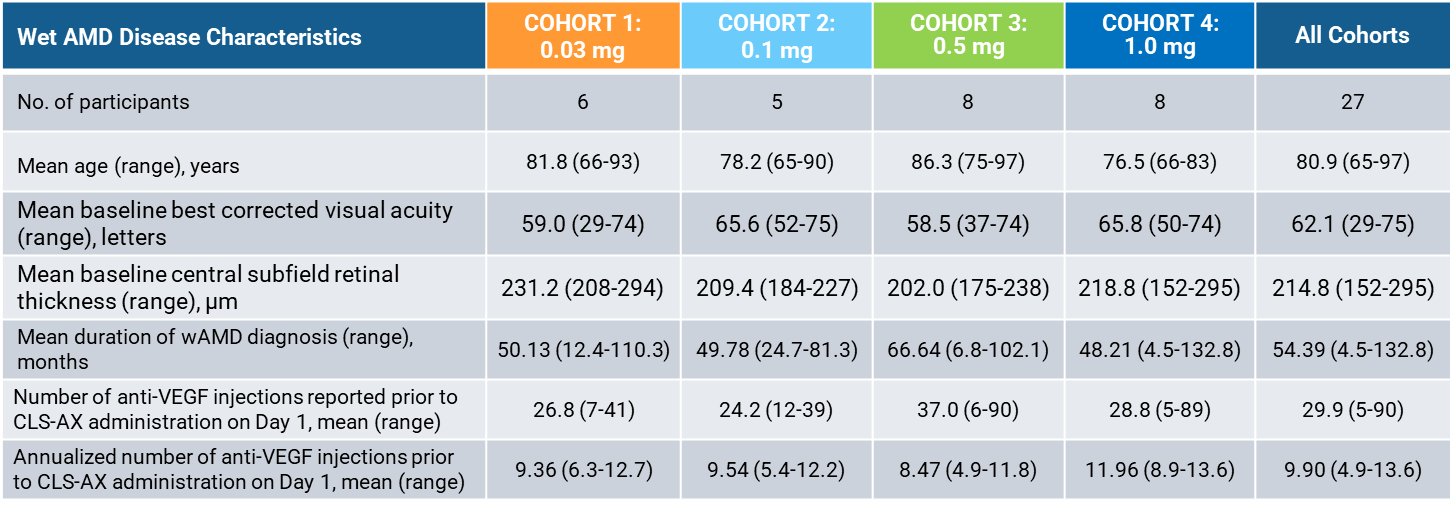
The OASIS 3-month open-label, dose-escalation phase 1/2a trial is complete. There is an ongoing additional 3-month Extension Study, for a total of 6 months of follow-up after a single dose of CLS-AX in patients from Cohorts 2, 3 and 4. All patients enrolled in OASIS were heavily anti-VEGF treatment experienced with active disease[1] at screening, which was confirmed by an independent reading center. Patient demographics and wet AMD treatment history are summarized in the following chart:
Safety and Tolerability Results (in All Four Cohorts, n=27)
- CLS-AX met the trial’s primary endpoint, demonstrating a positive safety profile at all doses and timepoints.
- There were no serious adverse events, no treatment emergent adverse events, no dose limiting toxicities, no adverse events related to inflammation, vasculitis or vascular occlusion.
- There were no vitreous “floaters” or dispersion of CLS-AX into the vitreous, no retinal detachments or endophthalmitis, and no adverse events related to intraocular pressure.
Durability (in Cohorts 3 & 4)
In OASIS to the 3-month timepoint (n=16):
- 69% of patients did not receive additional therapy
- 92% of patients did not receive additional therapy per protocol criteria
- 73% reduction in treatment burden from the average monthly injections in the three months before CLS-AX administration
In the ongoing Extension Study, based on interim data as of 10/27/22 (n=12):
- Supplemental anti-VEGF injection-free rate up to each visit
- To Month 5: 88% (7/8) of patients did not receive additional therapy
- To Month 6: 75% (3/4) of patients did not receive additional therapy
- 90% reduction in treatment burden from the average monthly injections in the six months before CLS-AX administration
- 8 patients remain in the Extension Study with final 6-month data expected in Q1 2023
Biologic Effect (in Cohorts 3 & 4)
- In OASIS, CLS-AX showed signs of biologic effect with stable mean BCVA and stable mean CST to the 3-month timepoint.
- In the ongoing Extension Study, CLS-AX showed signs of biologic effect with stable mean BCVA and stable mean CST to the 6-month timepoint (based on interim data as of 10/27/22).
- On OCT, anatomical signs of TKI biologic effect were observed in anti-VEGF treatment experienced sub-responders.
References
1. Active persistent disease defined as active subfoveal choroidal neovascularization (CNV) secondary to AMD in the study eye confirmed by an independent reading center as leakage from a subfoveal CNV on fluorescein angiography and intra-retinal or sub-retinal fluid on OCT central subfield).