
Altris AI Introduces AI-Powered Fluid and GA Quantification Features

Altris AI, which utilizes artificial intelligence for OCT scan analysis, has unveiled additional quantification features for fluids and geographic atrophy (GA) tracking on its web platform. Altris AI currently detects more than 70 retina pathologies and biomarkers. The platform's capabilities were recently enhanced by adding additional fluids and GA quantification and tracking functionalities.
"These advancements empower eye care professionals (ECPs) with cutting-edge tools for diagnosing and managing retinal diseases. By integrating AI-driven quantitative tracking and progression monitoring, Altris AI enables specialists to deliver more personalized and effective treatments, ultimately enhancing patient outcomes," the company stated in a news release.
Fluid Quantification and Progression Tracking
The presence of fluids such as intraretinal cystoid fluid (IRC), diffuse edema, subretinal fluid (SRF), and serous retinal pigment epithelium (RPE) detachment are critical biomarkers for conditions like wet AMD, DME, DR, and RVO. Accurate detection, quantification, and tracking of these fluids are essential for monitoring disease activity, evaluating treatment efficacy, and making informed prognoses.
Altris AI said it created specialized more detailed functions which detect these biomarkers for more specific and accurate tracking. The AI algorithm was trained to work directly with fluids considering the importance of these biomarkers for accurate diagnostics.
Altris AI’s advanced algorithms, trained on millions of OCT scans, are designed to provide precise and objective fluid analysis. Each of the four fluid types is localized and color-coded for clarity. Quantitative metrics such as volume, area, and ETDRS grids (1, 3, and 6 mm) are calculated and presented in mm3 or nanoliters for comprehensive evaluation. The Progression Tracking feature offers historical trend analysis with intuitive visualizations through graphs and percentages.
Precision in Geographic Atrophy (GA) Monitoring
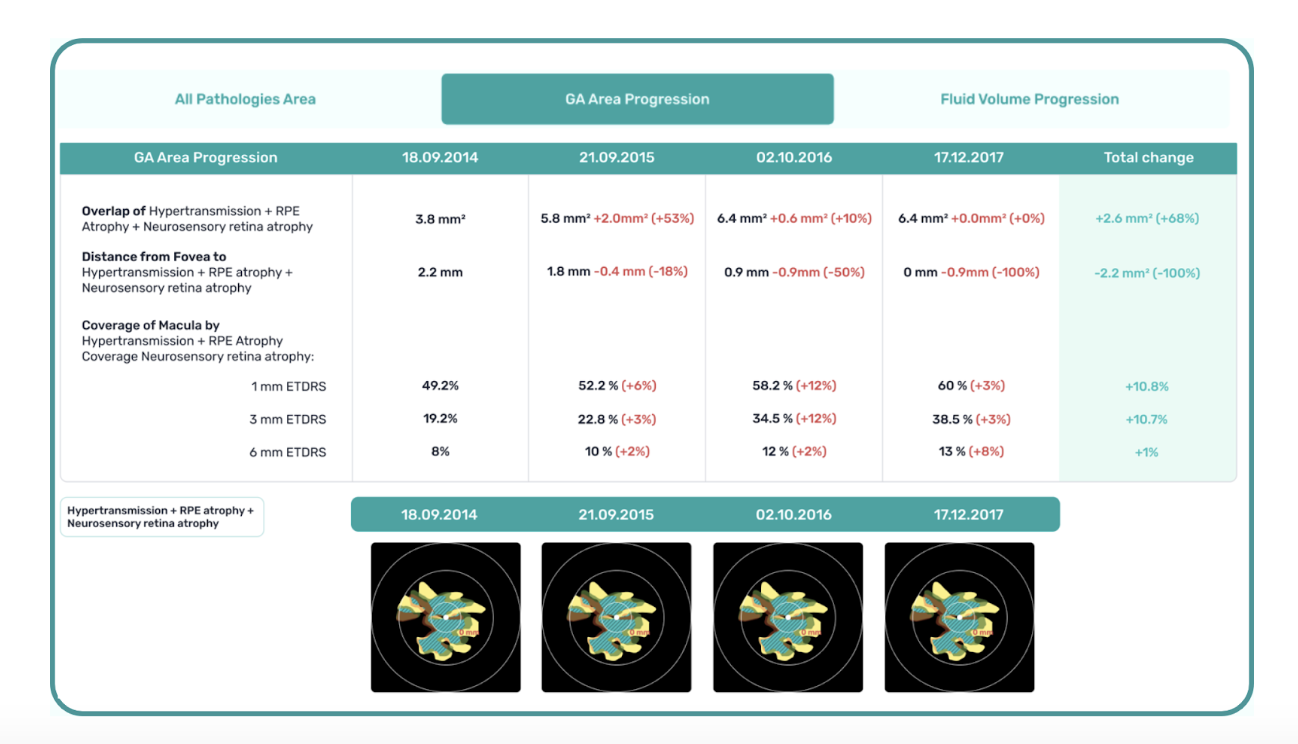
"Recent advancements in GA treatment have led to a growing need for large-scale screening in clinical practice. However, this increased demand often means higher workloads and less time for in-depth analysis," the company stated. "Altris AI's new GA quantification module facilitates automated detection, quantification, and tracking of GA by analyzing key biomarkers: pigment epithelium (RPE) atrophy, hypertransmission, neurosensory retina atrophy, and ellipsoid zone (EZ) disruption. These biomarkers are color-coded for easier identification."
The platform can assess GA using three key criteria:
Overlapping region of 3 biomarkers: Hypertransmission, RPE Atrophy, and Neurosensory Retina Atrophy (the GA zone).
The shortest distance from the Fovea center to the GA zone.
Percentage of the GA zone covering the 1 mm, 3 mm, and 6 mm ETDRS grid areas.
The platform is also designed to improve the accuracy of a critical step in our AI pipeline: the fovea and central scan detection. In cases when the center cannot be distinguished due to pathology presence or other reasons, the model is trained to analyze the whole surface and find reference locations from which a central scan could be determined. The new model can find an accurate center in 95% of cases, according to Altris AI, in other situations, it can efficiently estimate the center location (as opposed to a simple analysis flow used by ECPs where the geometrical center is selected). This advancement significantly enhances the precision of GA detection.
Further Progression Tracking enhances GA management by visualizing changes over time, supporting timely and accurate treatment decisions. By streamlining workflows and providing actionable insights, this feature helps ECPs make informed choices and potentially preserve vision in GA patients.
“We listened to our clients and introduced Fluid and GA tracking features. In 2025, eye care specialists will have the tools to combine their expertise with next-generation AI technology to tackle conditions that threaten vision effectively," Maria Znamenska, MD, PhD, and a Chief Medical Officer at Altris AI, said in the news release. "Our formula is simple: detect, quantify, and track fluids, GA, and 70+ retina pathologies and biomarkers for better patient outcomes."