Cocaine-Induced NAION
Subretinal fluid had a significant effect on this patient’s vision.
A 57-year-old Caucasian male presented as an emergency patient, reporting that the inferior visual field in his left eye was shaded. He said he noticed the onset occurred 48 hours prior, with no improvement since. Additionally, the patient stated that the night before onset, he had been snorting what he believed to be pure cocaine. He added that after a few bouts of inhalation, his peers had shared with him the possibility that the cocaine had been cut with methamphetamine.
RETINA IN CRISIS
The patient denied any systemic history and said he was not using any medications. He also denied any family history of systemic or ocular conditions.
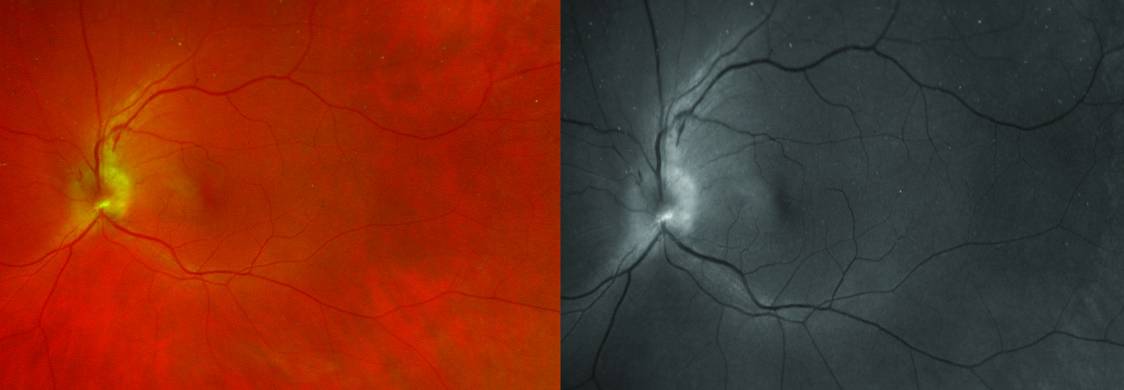
His entering VA was 20/20 OD and 20/30 OS. Entrance testing revealed a grade 1 afferent pupillary defect OS and constriction inferiorly on confront-ation fields OS. His blood pressure was 140/100 mm Hg, and his IOP was 17 mm Hg OD and 14 mm Hg OS. Dilated fundus examination revealed a diffuse edematous optic nerve OS, mainly concentrated superiorly with two overlying striated hemorrhages, and associated subretinal fluid in the macula OS. He had a small cup-to-disc ratio of 0.2 OD, consistent with a classic “disc-at-risk.” OCT revealed diffuse edema with superior concentration in the optic nerve head and confirmed subretinal fluid in the macula (Figure 1). Fundus photos were also taken (Figure 2).


PUTTING THE PIECES TOGETHER
The patient denied the telltale giant cell arteritis (GCA) symptoms of fever, headache, anorexia/weight loss, neck pain, jaw claudication, scalp pain, ear pain, fatigue, myalgia, and general malaise. Regardless, he was referred to the ER for a CT scan of his brain and orbits with and without contrast to rule out an infectious or compressive etiology. CT revealed no intracranial or orbital abnormalities. Additionally, bloodwork, including erythrocyte sedimentation rate and C-reactive protein, was unremarkable. Given these findings, a temporal artery biopsy was not performed. After stabilizing his high blood pressure, he was discharged from the ER.
The patient returned to our clinic the next day with worsening optic nerve edema and subretinal fluid (Figure 3). Visual field testing showed an inferior altitudinal defect consistent with the superior optic nerve head thickening seen on OCT (Figure 4). Given the patient’s vision in his left eye, his clinical signs, and the results of testing, we diagnosed him with nonarteritic anterior ischemic optic neuropathy (NAION).


THE DRUG CONNECTION
NAION is generally accepted to be associated with vasculopathic risk factors that increase the likelihood of low blood perfusion to the optic nerve.1 As such, it can present in patients who use certain medications, such as GLP-1 agonists, or illegal drugs that contain vasoconstrictive properties, such as cocaine and methamphetamine.2-4
While research has shown that subretinal fluid is associated with NAION—with studies finding a concurrence rate of about 15%—it is difficult to determine whether the subretinal fluid is secondary to NAION or to central serous chorioretinopathy, which can also be caused by sympathomimetic agents, such as cocaine and methamphetamine.5-9 Fortunately, NAION holds a moderate prognosis, with affected patients typically eventually regaining visual acuity and their full visual field.1
In this case, the patient’s uncontrolled hypertension and cocaine use were likely contributing risk factors for NAION, through mechanisms of impaired perfusion and underlying vasculopathy.
CASE OUTCOME
The patient was prescribed an NSAID 0.5% four times a day OS and a corticosteroid drop 1% four times a day OS to reduce the subretinal fluid. Although the subretinal fluid was self-limiting, ophthalmology opted to start the drops for faster resolution.
The patient continued to be followed by our clinic every 2 weeks for the following 3 months. At the most recent follow-up, 3 months after the initial encounter, the subretinal fluid completely resolved, and the optic nerve edema had significantly decreased (Figure 5). The patient’s inferior altitudinal defect did not improve, and he has not returned.

PEARLS FOR THE OD
This case highlights the importance of obtaining a thorough patient history, especially regarding sensitive topics, such as illegal drug use. This history provides a comprehensive understanding of a patient’s circumstances, which is imperative for accurate diagnosis, timely referral, and further intervention. Assure patients that all information is confidential and relevant when it comes to medical diagnoses.
Additionally, patients over 50 years of age who present with optic nerve edema should always be evaluated for GCA to prevent the associated risk of permanent vision loss.10
FORWARD-THINKING OUTLOOK
Currently, the FDA is fast-tracking a nasal spray containing cenegermin-bkbj (Oxervate, Dompé) to treat NAION. The drug is capable of bypassing the blood-brain barrier and delivering the neurotrophic protein into the central nervous system. The phase 3 study started in April and will end in September.11,12
Ready to Claim Your Credits?
You have attempts to pass this post-test. Take your time and review carefully before submitting.
Good luck!